
DUBLIN, IRELAND
A single line in Ireland’s 1926 census led from a Georgian doorway to Mainie Jellett—the artist who helped force modernism into the Irish conversation.
- Status
- Closed
- Location
- 36 Fitzwilliam Square West, Dublin, Ireland
- Period currently documented
- 1926
- Research
- Verified
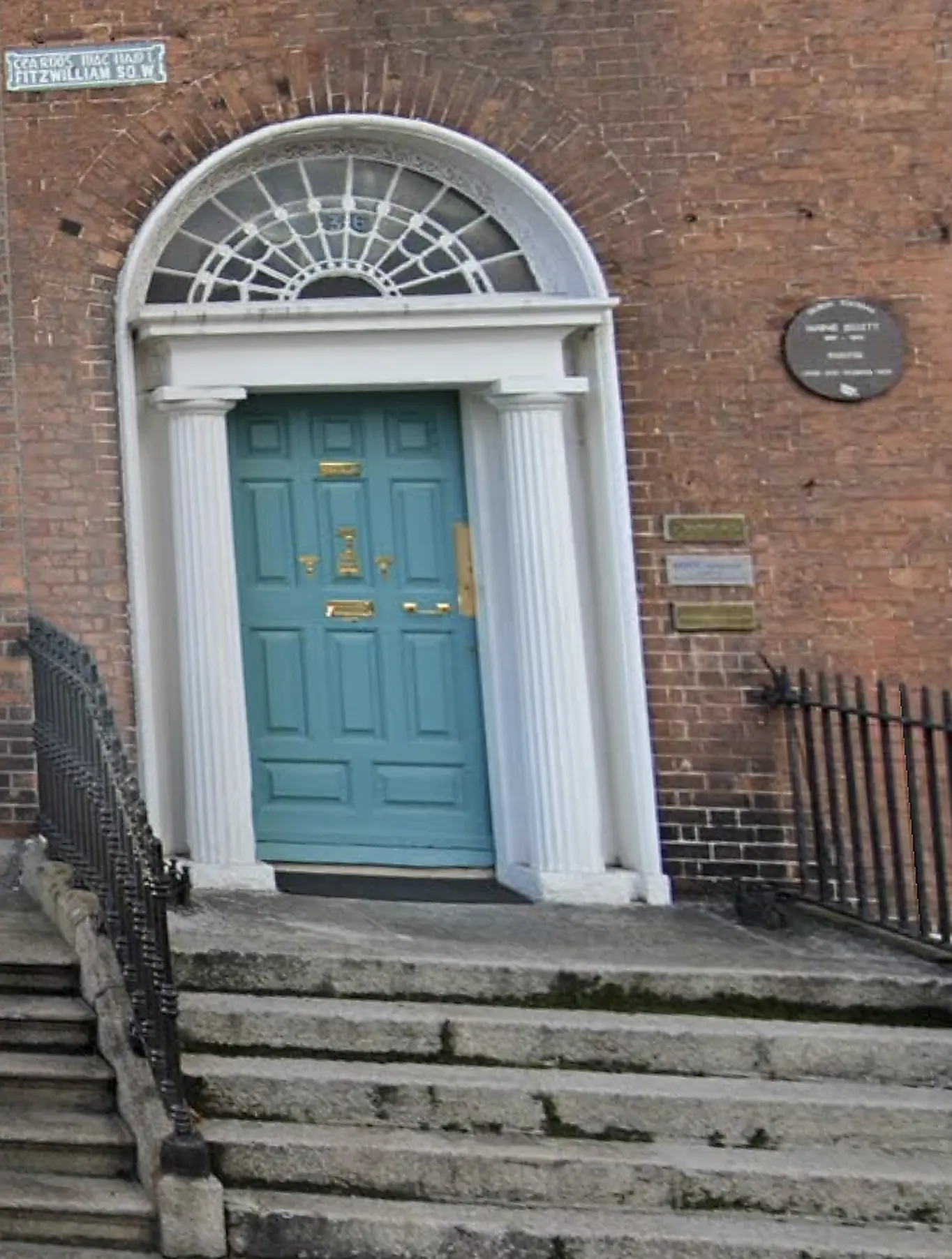
The doorway at 36 Fitzwilliam Square West first gave us an address. The 1926 census gave us a name: Mainie Jellett.
The National Inventory of Architectural Heritage dates No. 36 to about 1825 and describes it as the last townhouse constructed on the west side of Fitzwilliam Square. More importantly for this file, the architectural record identifies the building as Jellett’s home and studio.
That makes this more than an address associated with her after the fact. It is a surviving place where domestic life and artistic work met—a Georgian house connected directly to one of the most disruptive figures in the story of Irish modern art.
On 18 April 1926, the census recorded Mainie Jellett at 36 Fitzwilliam Square West. Her occupation was entered in notably direct terms:
Artist—Own Account
It is a small bureaucratic phrase, but an unusually revealing one. Jellett was not described through a family relationship or an amateur accomplishment. The return identified her by her profession and recorded that she worked on her own account.
The census cannot tell us which rooms she used as a studio, what stood on her easel that evening or which conversations took place inside the house. What it can do is place an independent working artist behind this precise doorway on a precise date.
Together, the census and architectural records connect the person, the profession, the home and the studio.
By the time of the census, Jellett had already crossed a considerable artistic distance.
She trained in Dublin and London before moving to Paris in 1920. There, alongside her friend and fellow artist Evie Hone, she studied with André Lhote and the Cubist painter Albert Gleizes.
Those encounters helped Jellett develop a way of constructing pictures through rhythm, colour and geometric form. Rather than treating a painting as a window onto a recognisable scene, she explored how shapes, planes and colours could create their own visual order.
Her Paris training did not simply sever her work from older traditions. It gave her new tools for reorganising them. Religious imagery, familiar formats and inherited pictorial structures could be rebuilt through abstraction.
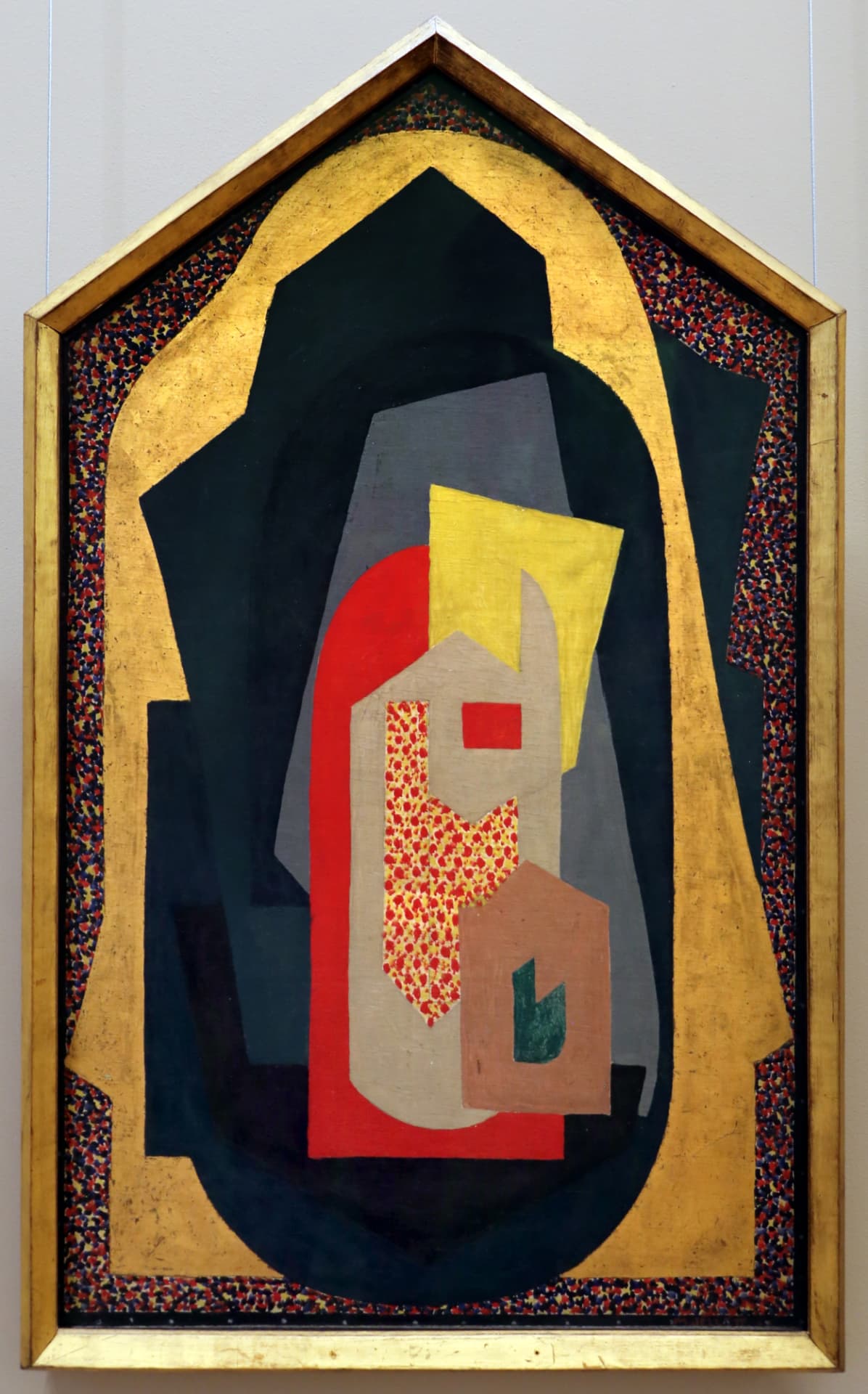
That new visual language confronted Dublin audiences in 1923.
Decoration is painted in tempera on a wood panel and measures 89 by 53 centimetres. Although essentially abstract, its tall format, colour range and panel construction recall devotional icons—particularly traditional images of the Madonna and Child.
When it appeared in a Society of Dublin Painters group exhibition, the response was hostile. One Irish Times critic described the work as “an insoluble puzzle.” Another journalist dismissed it as “sub-human art.”
The criticism reveals how unfamiliar abstraction still seemed in Ireland. Viewers were being asked to encounter a painting that did not describe the visible world in an expected way. Its subject had to be found through relationships of colour, balance, rhythm and form.
What looked incomprehensible to many viewers in 1923 is now recognised as a landmark in the arrival of modernism in Irish art. Decoration entered the National Gallery of Ireland through a 1955 bequest from Evie Hone—the artist who had studied beside Jellett in Paris.
Five years after Decoration unsettled Dublin audiences—and only two years after the census placed her at No. 36—Jellett’s work appeared on a very different international stage.
Mainie Jellett competed in the arts competition at the 1928 Olympic Games in Amsterdam.
Art competitions were then part of the Olympic programme alongside sport. The Olympic Federation of Ireland records Jellett as one of nine Irish artists who submitted works to the accompanying exhibition at Amsterdam’s Municipal Museum, held from 12 July to 12 August 1928. Its athlete record assigns her Team Ireland number 53.
The surviving source identifies her as an Olympic arts competitor. It does not record her as a medal winner, and it does not identify the exact work she submitted.
The Olympic record adds unexpected scale to the brief census description “Artist—Own Account.” Within two years of that census night, the artist working from No. 36 was participating in an international Olympic cultural programme.
Jellett’s art did not remain fixed in the language of Decoration. She continued to test what abstraction could contain.
The later works on this page show a visual vocabulary still in motion: interlocking planes, compressed forms and carefully controlled colour, but also an increasing engagement with landscape, the figure and religious subject matter.
This was not a straightforward retreat from abstraction. It was an attempt to bring modern construction and inherited imagery into the same picture. By the early 1940s, Jellett was integrating landscape and figurative details with traditional subjects while retaining the structural lessons of Cubism.
Jellett’s influence was not confined to her own paintings.
In 1943, she chaired the committee responsible for the inaugural Irish Exhibition of Living Art. The initiative was created to provide a platform for living and younger artists at a time when experimental work could struggle to find space within Ireland’s more conservative exhibition culture.
The National Gallery of Ireland describes it as a ground-breaking initiative that helped prepare the way for developments in Irish art during the 1950s and 1960s. IMMA identifies Jellett as central to its establishment and now describes her as a leader of Irish modernism.
The argument that began around one supposedly incomprehensible painting in 1923 had therefore become something larger by 1943: an effort to make lasting room for new art and new artists.
No. 36 does not explain Mainie Jellett. It does something more useful: it places her.
The house survives. The census records her presence and profession. The paintings reveal what the word “artist” could mean at a moment when abstraction was forcing its way into the Irish conversation. The Olympic record shows that her work also travelled beyond that conversation, while the Irish Exhibition of Living Art shows her helping to reshape the conditions in which other artists could work.
This is the logic of The Doorway Files: a façade leads to a record; the record leads to a person; and the person opens onto a much larger history.
At No. 36, one line in a census opens onto modernism, public hostility, international competition and the building of a new artistic platform.
The doorway remains the visual anchor. The records reveal the human connection.
What we know
- •The NIAH dates No. 36 to approximately 1825, identifies it as the last townhouse constructed on the west side of Fitzwilliam Square, and records it as Mainie Jellett’s home and studio.
- •The 1926 census records Jellett at 36 Fitzwilliam Square West on 18 April 1926.
- •Her occupation was recorded as “Artist—Own Account.”
- •Decoration provoked a hostile reaction when exhibited in Dublin in 1923 and is now in the National Gallery of Ireland.
- •Jellett competed in the arts competition at the 1928 Amsterdam Olympic Games as one of nine participating Irish artists.
- •In 1943, she chaired the committee of the inaugural Irish Exhibition of Living Art.
What we don't know
The records used for this file establish Jellett at No. 36 on census night in 1926, while the NIAH identifies the building as her home and studio. They do not yet establish the precise beginning and end of her residence, which rooms she used for her work, or which paintings were made inside the house. The Olympic record consulted for this story also does not identify the work Jellett submitted in Amsterdam.
National Archives of Ireland — 1926 census record for 36 Fitzwilliam Square West
- Household return connecting Mainie Jellett to 36 Fitzwilliam Square West
National Inventory of Architectural Heritage — 36 Fitzwilliam Square
- Architectural record for 36 Fitzwilliam Square West, Dublin
National Gallery of Ireland — Decoration by Mainie Jellett
- Collection context for Decoration, 1923
Olympic Federation of Ireland — Mainie Jellett, Amsterdam 1928
- Record of Jellett’s participation in the 1928 Olympic arts competition
International Olympic Committee — History of Olympic art competitions
- History of the Olympic arts competitions
Irish Museum of Modern Art — Mainie Jellett
- Artist biography and modernism context
National Gallery of Ireland — The Virgin of Éire and the Irish Exhibition of Living Art
- Context for the Irish Exhibition of Living Art
Wikimedia Commons — Decoration
- Photograph by Sailko; licensed under CC BY 3.0
Wikimedia Commons — Composition, circa 1930–1939
- Photograph by Sailko; licensed under CC BY 3.0
Wikimedia Commons — Abstract Composition, 1935
- Public-domain image via Wikimedia Commons
Creative Commons Attribution 3.0 license
- License applying to the Sailko photographs
The doorway photograph is used editorially and educationally and remains confined to this FILE 006 article. Artwork and census images are reproduced with the credits and source links shown above.
FILE 006: CLOSED.
The surviving census return makes the address-to-name connection. The file is closed on the evidence currently available.
File 006
THE ARTIST BEHIND NO. 36
36 Fitzwilliam Square West, Dublin, Ireland
No Fiction. No Hype. Just What We Find.
The Doorway Files